OpenQuad: Open-Source Platform for Drone Autonomy
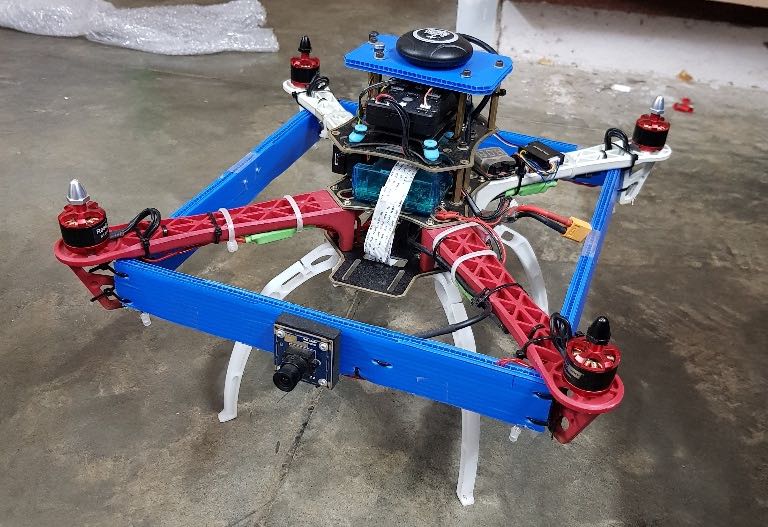
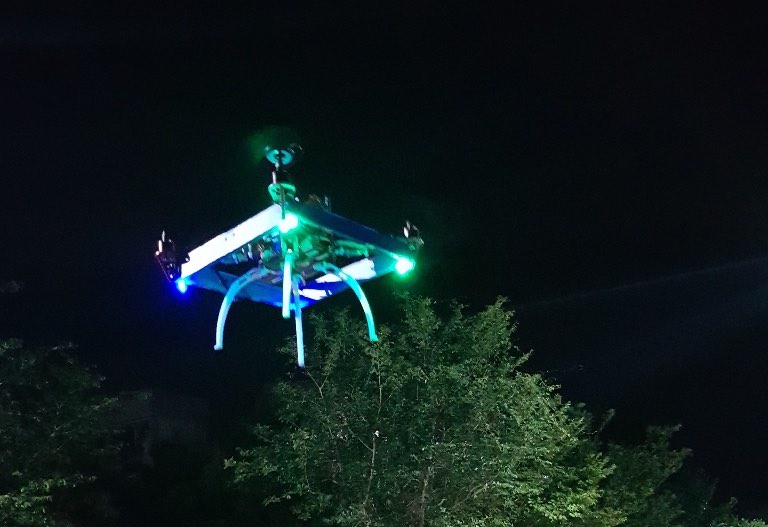
OpenQuad equips researchers with a reproducible quadcopter hardware and software stack that accelerates experimentation in gesture-based control, person tracking, optical flow stabilization, and monocular depth.
Project Overview
Led architecture and integration for an open-source quadcopter platform using a Pixhawk flight controller with Raspberry Pi companion compute. The goal was to provide a reusable baseline for rapid prototyping of autonomy algorithms that can transition from simulation to field tests with minimal friction.
Technology Stack
- Pixhawk flight controller paired with a Raspberry Pi companion computer.
- ROS command and control architecture with Gazebo simulation for validation.
- Dockerized development environment for repeatable setup across contributors.
- Python and deep learning frameworks powering perception and autonomy modules.
- Custom hardware mounts on the DJI Flame Wheel-450 to host sensors and compute.
Key Features
- Implements gesture control, person tracking, and obstacle avoidance pipelines.
- Introduces optical flow stabilization for disturbance rejection during flight.
- Delivers monocular depth estimation to inform reactive avoidance behaviors.
- Balances compute across Pixhawk and Raspberry Pi for mixed-critical workloads.
- Provides a modular airframe configuration for rapid sensor experimentation.
Simulation & Tooling
Established a ROS + Gazebo simulation environment packaged in Docker containers to streamline development and onboarding. Remote ROS nodes stream video from the quadcopter to a host PC, enabling high-fidelity testing before deployment and reinforcing the platform’s open-source ethos.
Conclusion
OpenQuad lowers the barrier for academic and hobbyist teams to experiment with aerial autonomy, providing an extensible baseline that balances hardware accessibility with advanced perception and control capabilities.